Emotive Audio Erato Tube Preamplifier
Tip #112
Dick Olsher (March 2026)
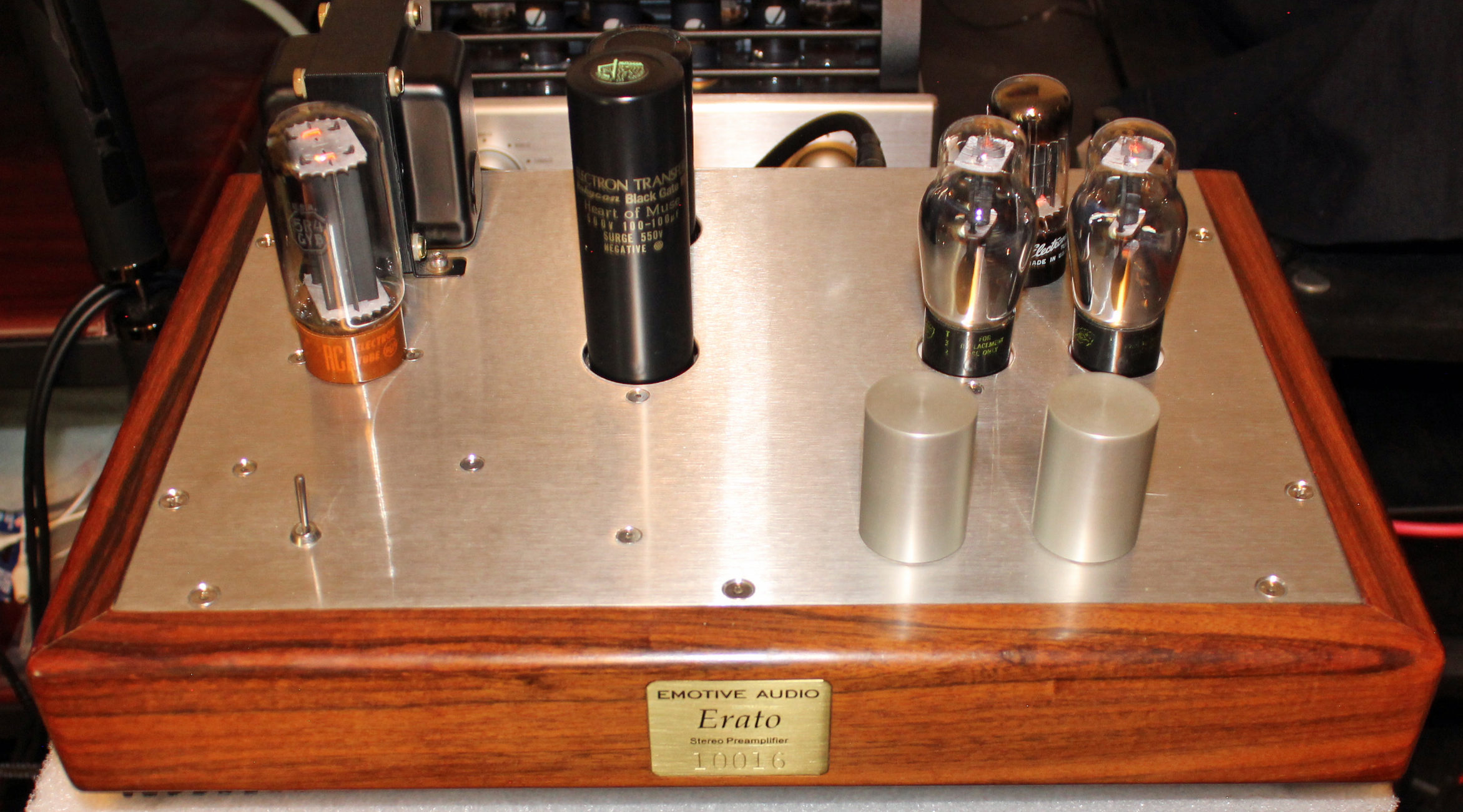
Although the type 27 triode had been used in a few DIY line stage designs, the only commercial example I know of is Emotive Audio’s Erato, introduced circa 1998 by designer Frederick Volz. That is hardly surprising as mainstream manufacturers would have naturally avoided the “insanity” of using an obsolete 100-year old tube that has been out of production for about 75 years. Kudos to Fred for having the audacity to do just that. This is one MUSICAL triode that in my experience sonically destroys most modern 9-pin miniature based designs. You should also know that Emotive Audio had since passed into the “hereafter” about a decade ago. However, Fred tells me the he still builds custom pieces once in a while, just as Frederick Volz. “We can and have made custom versions of the Erato, Sira, and Epifania, sometimes changing the audio tubes based on a person’s interest. So, building an Epifania that uses 27s instead of 12B4s is an example of the kind of thing I might do.”
The Erato was Emotive Audio’s second line stage preamp. It followed the Prima, a design based on a single 6SN7 voltage amplifier and a 6BL7 cathode follower. Only about 25 Erato units were produced, primarily due to the concern about availability of the 27 triode. “The Erato is fundamentally similar to the Prima but uses the type 27 triodes as voltage amplifiers while sticking with the 6BL7 cathode follower tube. To address audio quality issues associated with traditional cathode follower designs, we use high impedance solid state current sources for the cathodes of the 6BL7. The result is, we get a low output impedance for the preamp from the cathode follower design and still preserve the wonderful audio qualities of the type 27 triodes. From a design standpoint, the audio stage is very simple, but the power supply, including the active cathode circuit, is much more complex.” The 5R4 tube rectifier is also an essential design feature, as in my experience tube rectification is the only correct path toward vintage tube sound. The filament/heater power supply is DC and is well filtered, greatly lowering the noise floor.
A major reason I was tempted by and eventually purchased a used Erato was of course the 27 triode. I had actually designed a 27-based line stage many years ago and had already accumulated a cache of 27 tubes. So what is so special about the 27? According to John Stokes’ book “70 YEARS of RADIO TUBES and VALVES: “In May 1927 a practical form of single-ended tube fitted with a 5-pin base was announced by RCA under the type number UY-227. The 227 was a landmark tube as, apart from being the first standardized indirectly-heated tube, it ushered in the era of the mass-produced all-electric receiver. The 227 was the first tube to use both a standardized heater voltage and a standardized 5-pin base. The figure of 2.5 volts chosen for the heater voltage was to remain an industry standard for all types of AC tubes produced over the next five years. All UY-227s used S-14 [globe] sized bulbs until 1932 when the type number was officially changed to 27. From then on a smaller, ST-12 [coke bottle], bulb was used and the base diameter was reduced to match.”
 The 1930s turned out to be radio’s Golden Age and the type 27 had the field pretty much to itself until 1935 when production tapered off as new types were introduced (e.g. type 56). In all, millions of 27’s were produced by the likes of RCA Radiotron, Sylvania, Tung-Sol, GE, and National Union. Many of these were branded for radio manufacturers such as Philco and Silvertone (Sears).
Between 1927 and 1933 the cathode design underwent many changes and refinements. “In its original form the 227 used a hairpin-shaped heater, insulated from the cathode by means of a twin bore ceramic tube. A coating of metallic oxides was applied to the outer surface of the cathode tube which formed the electron emitter. This was in essence the principle of the indirectly-heated cathode. However, the actual form of construction was to undergo many changes and refinements during the next few years. A practical disadvantage resulting from the original form of construction was the long time taken for the cathode to reach emitting temperature and in an effort to improve matters a new design was introduced in 1928. This later production used a tightly coiled spiral heater supported and centered with the cathode by a porcelain bush at each end. Although the absence of any solid insulation between heater and cathode dramatically reduced warm-up time, the use of a single-coil heater resulted in an increased hum level which necessitated a further change. A return was made to the earlier style of construction in a modified form which resulted in an acceptably short warm up time coupled with a satisfactory hum level. For the next few years the twin-bore insulator remained in use on Radiotron tubes until finally ousted by the slip-coated heater which came into use from 1933 onwards.”
 Plate design also evolved during the early 30s. Initially, mesh plates were used by some manufacturers (e.g., National Union) in an ST-12 glass envelope. But by 1935 it seems that all manufactures had switched to solid, stamped metal plates, probably because of ease of manufacture. Today there is still a fair number of 27s available for sale on eBay and elsewhere, essentially all of these are used pull outs. They are fairly inexpensive, typically selling at about $10 or less per tube on eBay. Selecting a seller that accepts returns is essential as some 27’s may test fine but can be rather noisy. It’s true that the 27 triode tends to be microphonic, but that does not seem to impact sound quality. What does detract from sound quality are dirty and/or oxidized tube pins. The pins should be cleaned before use. I highly recommend DexoiT™ for this purpose which helps ensure good electrical contact.
Because the cut outs in the Erato’s aluminum top deck are sized for the smaller ST-12 type 27, I was limited to evaluating several such types in the context of the Erato. The RCA Radiotron and Sylvania brands sound great, but a recent acquisition, a pair of National Union mesh plate types that likely date from around 1933 are sonically to die for: plush, dimensional, focused, and super seductive.
The Erato has by now become one of my all-time favorite line stages. Driving my Audio Research VS115 power amp and Fyne Audio's F704SP point-source loudspeakers, the result is sweet and refined harmonic textures, basically wall-to-wall plushness. And above all else, superlative retrieval of the music's emotional content as a consequence of realistic dynamic gradations. Plenty of low-level is resolved to satisfy my needs, and definition of the bass octaves is quite impressive, especially for a tube preamp. I'm a tube guy and always have been, and the Erato pushes my buttons big time. Simple designs, but not too simple, in my experience work best.